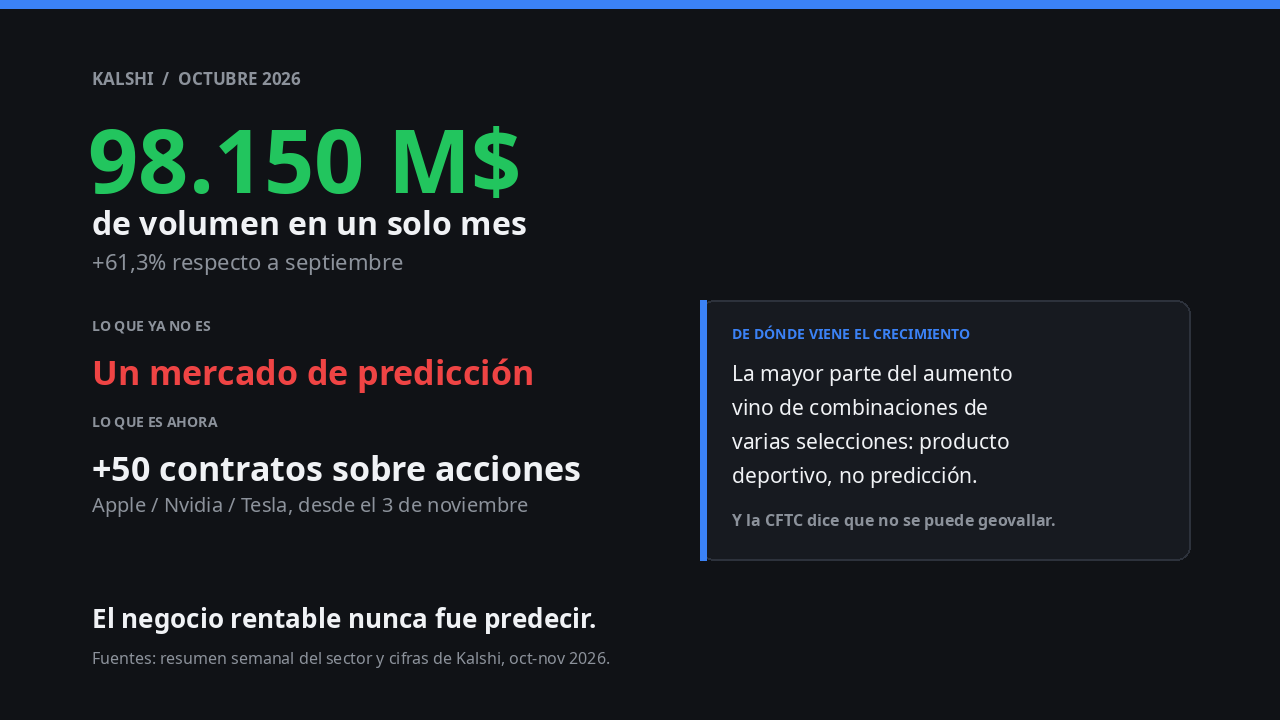
Kalshi started out selling contracts on whether something would happen. Today it trades perpetual futures on individual US stocks: more than 50 contracts including Apple, Nvidia and Tesla, live from 3 November. Its co-founder, Luana Lopes Lara, reported more than $300 million traded on the morning of 5 November alone.
That is no longer a prediction market. It’s a derivatives exchange with a different brand story.

The numbers that confirm it
- $98.15 billion in notional volume in October, up 61.3% on September.
- Across the eight federally regulated exchanges analysed, $126.64 billion.
- DraftKings DKeX, Novig and Underdog more than doubled their monthly figures.
And the detail that explains where the growth comes from: most of Kalshi’s increase came from multi-leg combinations, meaning sports product. The prediction market born to aggregate information is becoming, by volume, a bookmaker with an API.
The regulator just moved
On Thursday the futures authority (CFTC) published guidance stating that federally regulated exchanges generally cannot restrict access for US traders based on location.
That sounds technical and it’s enormous: it may collide head-on with court orders blocking sports contracts in certain jurisdictions. In other words, the federal regulator says “no geofencing” while courts say “you can’t operate here”.
The open fronts
- Tribes. Three California tribes secured a preliminary injunction barring Kalshi from offering sports contracts on their lands. Analysts note it is the first time Native American tribes have won such an order against the platform, opening the door to others.
- Supreme Court. Kalshi has sought review by the high court.
- Competition. Polymarket launched a perpetual futures competition with $50,000 in prizes from 2 to 16 November, requiring at least $100,000 in volume to qualify, with incentives tied to Anthropic’s pre-IPO valuation. It is unavailable to US customers.
What this means if you trade
- Check what you’re buying. A contract on “will X happen?” and an Apple perpetual are different products, with different liquidity, hours and risks. Same brand; different product.
- Look at who regulates each one. Oversight of an election market isn’t oversight of a stock derivative, and the rules can change separately.
- Distrust volume as proof of quality. $98 billion a month, mostly sports combos, tells you nothing about whether your specific market has a counterparty.
- And don’t confuse size with safety. Growing fast is exactly when platforms change rules, products and terms.
The honest reading
There are two ways to see this. The generous one: a platform that started by predicting elections has proved it can build liquid markets and compete with Wall Street. The less generous one: the profitable business was never prediction, it was the financial product, and prediction was the way in.
Both can be true. What no longer holds is calling this a “prediction market” without saying that its volume lives on sports and its future is in stocks.
Sources: product and volume data per the sector’s weekly round-up (31 October – 6 November 2026) and figures reported by Kalshi itself; CFTC guidance on geographic restrictions; the California tribes’ preliminary injunction and the Supreme Court review request; Polymarket’s competition per its announcement. Volume figures are from October and November 2026 and may be revised: check current data before trading.
Be the first to leave a comment