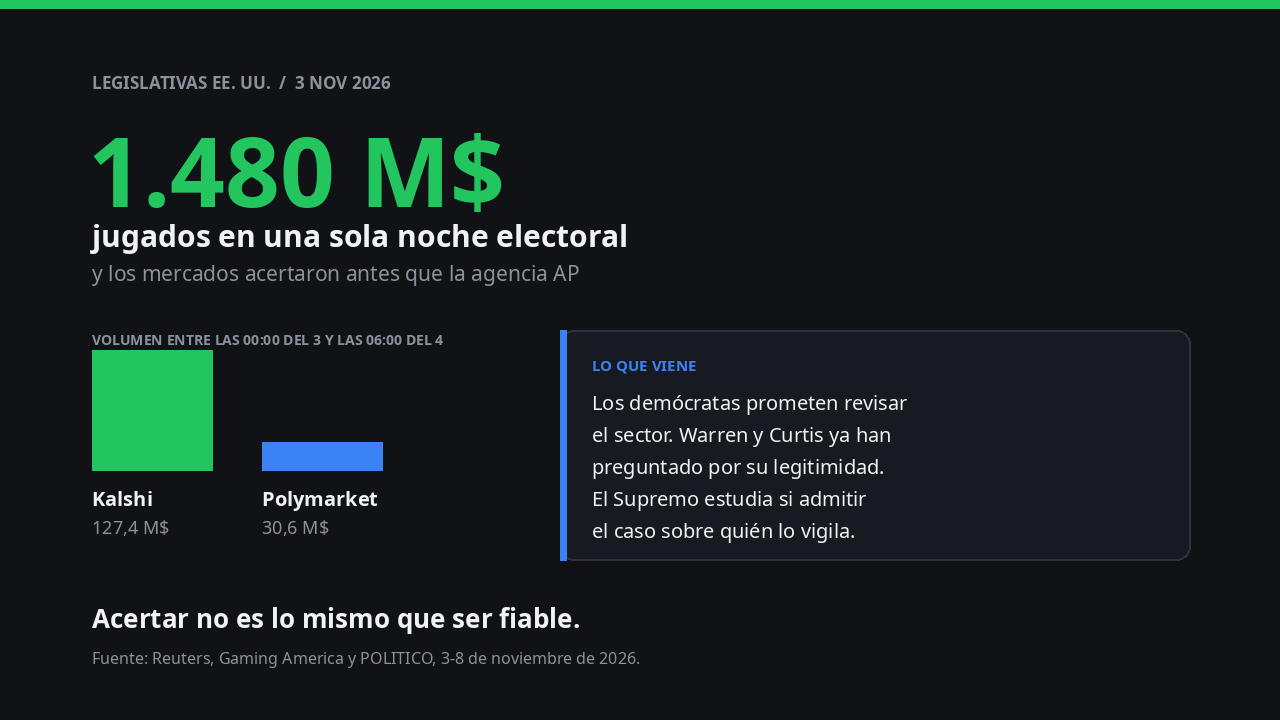
More than $1.48 billion was wagered on the US midterm elections of 3 November 2026. The Democrats won, and prediction markets called it before the Associated Press in several races. Kalshi and Polymarket celebrated their value as a forecasting tool.
And that success has opened exactly the door they didn’t want: political scrutiny.
What they got right, with data
- The 23 races that changed favourite on Polymarket during the day all swung towards the Democrats.
- In the eight races AP called overnight, both platforms hit 99% before the agency declared a winner.
- In Texas, Polymarket got there two hours before AP.
In other words: the market didn’t just get the overall result, it marked the turning point before the media did. That is what these platforms sell, and this time they delivered.

Who took the volume
Being right and making money aren’t the same thing, and here’s a difference almost nobody looks at. Between midnight on 3 November and 6am on the 4th:
| Market | Kalshi | Polymarket |
|---|---|---|
| Texas Senate | $36.6M | $4.1M |
| House control | $30.1M | $10.6M |
| Senate control | $25.2M | $7.4M |
| Michigan Senate | $12.4M | $2.6M |
| Maine Senate | $5.0M | $1.3M |
| All 11 markets | $127.4M | $30.6M |
Kalshi took 81% of the money traded across the two platforms that night. Kalshi’s cumulative cycle volume passed $2.8 billion, and adding Polymarket the combined total exceeded $3 billion in election markets, with more than 28,000 markets opened.
The bet that explains the rest
One figure from that night: $949,299 on a Democratic House, placed one minute after the first polls closed.
There’s no need to speculate about what whoever placed it knew. It’s enough to understand the mechanics: if someone can move almost a million dollars in the exact minute data starts arriving, your probability analysis is competing against information you don’t have.
The political turn, which is the real story
- Victorious Democrats have vowed to scrutinise the sector in the new year.
- Senator Elizabeth Warren, a possible next chair of the Senate Banking Committee, sent a letter with Republican John Curtis to the CEOs of Kalshi and Polymarket questioning the “legitimacy and regulation” of their election markets.
- The Supreme Court is weighing whether to take up a case on who should oversee these markets.
- The futures regulator, the CFTC, issued guidance stating that federally regulated exchanges generally cannot restrict access for US traders based on location, which may clash with court orders blocking sports contracts in certain jurisdictions.
What being right doesn’t fix
Critics point to three things a good forecast doesn’t solve:
- Odds can be skewed by speculation, thin liquidity and concentrated bets.
- Candidates bet on their own races; the platforms say they have tightened controls.
- Political markets can be moved with relatively small bets, according to research by the Anti-Corruption Data Collective cited by Reuters.
And the track record matters: the platforms boast of high accuracy, but they have had high-profile misses in US primaries and in Brazil’s presidential election.
The honest reading
This time they were right, with real money on the line. That counts in their favour and can’t be taken away.
But being right once isn’t the same as being reliable, and the sector has just discovered the problem with being right in public: if your business is saying what will happen, the day you get it right you become someone worth watching. The question is no longer whether they predict well. It’s who decides the rules of the game they’re predicting.
Sources: Reuters coverage (3 November 2026) on volume and oversight; Gaming America’s analysis of public trade data across the eleven election-night markets; cycle volume aggregates from NextPredict (31 Oct – 6 Nov); the Warren and Curtis letter and political context per POLITICO (8 November 2026); Anti-Corruption Data Collective research cited by Reuters.
Be the first to leave a comment