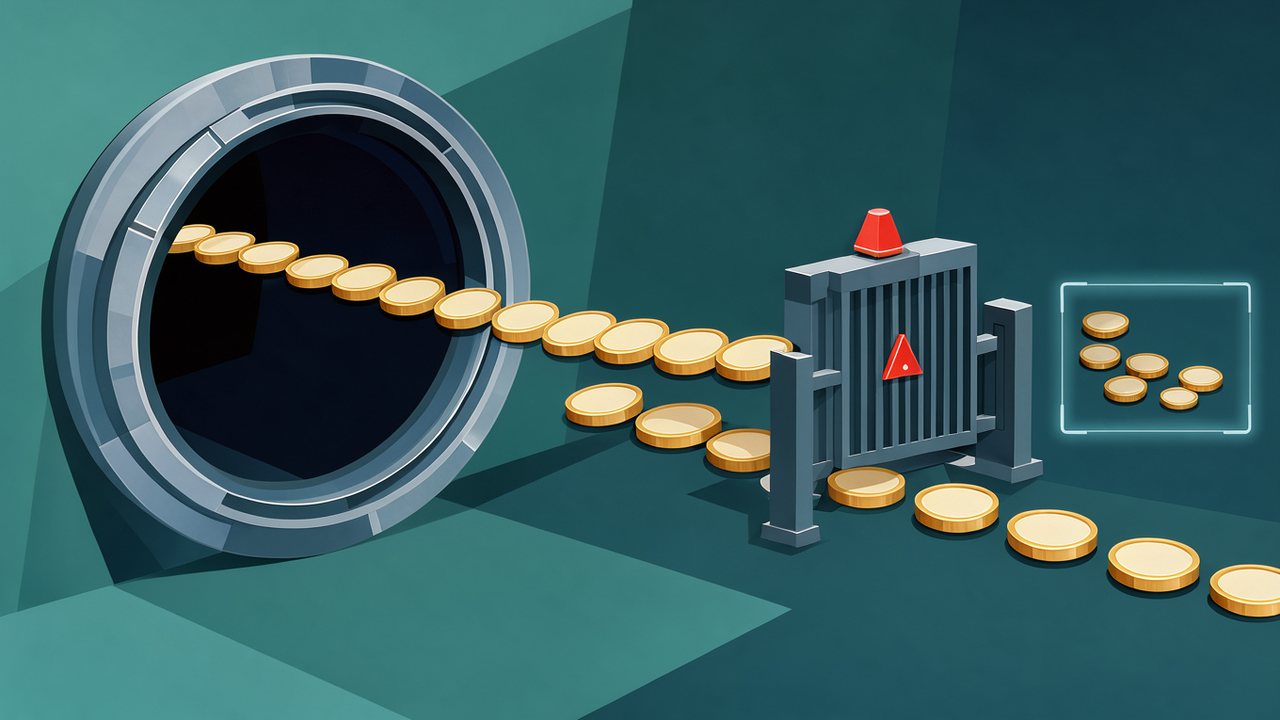
The Justice Department secured court authority over $1.2 billion of the $6.3 billion stolen from Binance, but the money was already frozen. Stablecoin issuers won the week; Binance lost on reputation and the root cause is still unpublished.
On 12 November 2026 the U.S. Department of Justice said it had obtained court authorisation to seize or restrain more than $1.2 billion in cryptocurrency stolen from Binance, the exchange at the centre of the largest heist the industry has seen. The wording carries most of the story: the funds had already been frozen by the time the order arrived, so the action is a claim of legal control over the money, not a fresh recovery of it.
What is known
The theft happened on 29 October. Binance put its own loss at roughly $6.3 billion, about four times the February 2025 Bybit breach. The tracing firm TRM Labs counts about $6.36 billion across ten blockchains, most of it moved in roughly twenty minutes starting at 20:05 UTC on 29 October.
The FBI and Binance attribute the attack to TraderTraitor, the North Korean military-linked unit the bureau named in the Bybit case. Within hours of the disclosure, Tether, Circle, Ripple and World Liberty Financial froze about $2.67 billion in stablecoins tied to the flows, according to TRM’s count as of 00:30 UTC on 30 October. Officials now put the combined government and private freeze at more than $2.7 billion, with the DOJ describing its $1.2 billion authorisation as part of that total rather than an addition to it.
The same week, the DOJ said it had disrupted cloud infrastructure used in a social-engineering campaign it calls FaceStealer, which investigators tie to more than $400 million of thefts over the past eighteen months. On 12 November Binance said it had finished covering the affected customer assets and published an updated proof-of-reserves snapshot.
Why the freeze worked this time
Stablecoins sit on public ledgers, but their issuance is centralised. That lets an issuer quarantine an address in a single transaction, which is why a chain of wallets that would take days to trace on a fully decentralised system can be isolated in hours. The catch is discretion: some of these freezes appear to have been voluntary rather than compelled by a lawful order, and an issuer that can freeze funds can also decline to.
Who wins
The clearest winners are the stablecoin issuers. Freezing more than $2.6 billion within hours is exactly the technical capability the GENIUS Act expects permitted issuers to demonstrate, and it hands the industry a showcase argument in Washington: regulated dollar tokens can act as a choke point when an attacker tries to move stolen money.
Authorities gain a political win as well. The DOJ and FBI can point to court orders and to the takedown of hacking tools, and the CFTC’s chairman had already used the breach to argue that crypto markets need the same safeguards as traditional venues.
Who loses
Binance loses on reputation, whatever the technical detail. A $6.3 billion loss at the world’s largest exchange becomes a reference point every competitor will use, and the company still has not published a root-cause report. Traders paid a second price: the shock landed in a market already sliding, and the days that followed brought heavy liquidations and ETF outflows.
North Korea is the other loser on paper, but only partly. Freezes reach the money that passes through issuers and regulated venues. The attacker reportedly still controls roughly $2.4 billion beyond any issuer’s reach.
What is still unknown
- The root cause is contested. Binance’s preliminary account points to a compromised DevOps engineer’s laptop that gave access to a service container and allowed unauthorised withdrawals. TRM’s analysis points instead to a compromise of the exchange’s hot-wallet signing infrastructure. Binance has not published a root cause.
- Frozen is not returned. The $1.2 billion sits inside the larger frozen total; ownership and forfeiture proceedings are unresolved. Nothing yet establishes that victims will receive it.
- The rest is still moving. Investigators say the actors keep laundering through bridges, mixers and exchanges, so the final split between what is recovered and what is gone remains open.
The practical read
Political pressure is rising in parallel. Senator Richard Blumenthal has sent letters to Binance, Tether, World Liberty Financial and Fight Fight Fight LLC, with a 4 January 2027 deadline for documents, as part of a Senate Permanent Subcommittee on Investigations review. None of those letters is a finding of wrongdoing.
The number to watch is therefore not $1.2 billion. It is how much of the $6.3 billion ends up back in customers’ hands, and how quickly the industry publishes technical findings that would let other exchanges check whether the same signing path exists inside their own systems.
Be the first to leave a comment